Showing posts with label culture. Show all posts

Tuesday, May 12, 2015

Bomba and Plena: Los Pleneros de la 21's Las Fiestas de Cruz - Saturday May 16, 2015

La familia of Los Pleneros de la 21 are proud to invite everyone to our 29th annual celebration of a time-revered tradition, LAS FIESTAS DE CRUZ.

Join us for an evening of inspiring and soul-stirring music by members of the LP21 ensemble as we interpret traditional chants and devotional songs to La Cruz, honor the memories of those we have lost and those whom have come before us, and provide joy and solace for our community.

ONE NIGHT ONLY!!!!

SATURDAY MAY 16TH 2015
7:00 PM
Julia de Burgos Center 
(1680 Lexington Avenue, NY NY 10029)


So join us for an evening of 

LIVE MUSIC
FAMILY AMBIANCE
FOOD AND BEVERAGES
ARTS & CRAFTS

all for a (suggested donation) of $5.00

For more information
212-427-5221

pleneros21@gmail.com

Las Fiestas de Cruz is a long-standing and profound tradition that has developed and been practiced in Puerto Rico (as well as other Latin American countries) for over 200 years. It has a unique characteristic of bringing together different members of the community--from different backgrounds, professions, and ages--to give thanks for the year's successes and to gain strength for challenges faced--all through song, music and dance. Through everyone's active participation in these (the audience members raise their voices in chorus and revelry to accompany the music and chanted rosaries), the Fiestas de Cruz can hold very personal and specific importance to all those in attendance, and are often electrifying and inspiring.

Las Fiestas de Cruz is part of LP21's Cultural Legacy Initiatives and is made possible in part by support from the New York State Council on the Art and Governor Andrew Cuomo's Office, the National Endowment for the Arts and individuals like you!

Tuesday, April 22, 2014

NY Bomba: Video Premiere of Bambula - Coming Soon in 2014


4-18-2014
"Bambulá" is a Spoken word video by artist 'Q&A' performed with the Bomba Group Grupo Bambulá and is set to release on April 21st of this year. The video itself offers rich insight into Puerto Rican culture and history as it features Bomba, an Afro-Puerto Rican folkloric music, as a core cultural component. This collaboration features ‘Q&A’, a young poet, with Norka Nadal and her group Bambula; Directed By Dayv "Mental" Cino of www.MALAandMENTAL.com.
‘Q&A’, known for his poetry that addresses current social and cultural issues, had been longing to complete this project. “I wrote the poem at 4am and once I finished and read it completed I just knew I had to do this.” He reached out to Dayv Cino who is well known in the NYC underground Hip Hop scene for his clothing line (Revolutionary Minded Gear) and video production, he was more than willing to offer his services. ‘Q&A’ says he then reached out to Norka Nadal Hernandez, his Bomba teacher who instructs on the Mayagüez style of the genre, confident in her talent and musical ability. The video opens with a song segment performed by Norka Nadal Hernandez and Grupo Bambulá followed by the actual spoken word piece, and ends with a classic Bomba song. Bomba music was brought to Puerto Rico by enslaved African peoples who were forced to labor in the islands plantations. Although the music was played during festivities in the face of adversity it was also utilized as a tool for organizing rebellions against colonial slave masters. The inclusion of Bomba itself is a statement as the music has been marginalized and suppressed for years due to its powerful African roots. Bomba only became widely acknowledged in recent years through to some of the work by the ICP (Puerto Rican Cultural Institute) and especially after the release of the film Raices which added to its popularization. Though appreciated by many, the film watered down the genre in the eyes of many artists to present a palatable version for the mainstream. The ICP, though preserving Bomba, has left it largely to performances and historic presentation, essentially separating the communal component. “Bomba just had to be in this piece. The poem has Bomba in it!” says ‘Q&A’. He continues, “If you look at Bomba, like many other traditions, it’s not fitting to say it’s a thing of the past if we wish to uphold and preserve it. Bomba always spoke of current events, communal gossip, and social issues. It shouldn’t just be placed on a pedestal as a cultural point of reference but also carried in the present. By putting Bomba with my spoken word I intend to let the youth know that this is our tradition and it’s ours to take so long as we carry it right, respecting those before us. I was honored to collaborate with those like Norka and Joe who’ve taught me what they know. Bomba holds the tears and voices of our ancestors and we must ensure that it echoes past our lifetime for its rightful heirs to hear. ” The video does not offer any watered down attempt at mainstream recognition but a real and authentic Bomba format beginning with a song sang by Norka Nadal Hernandez with a Yubá Mason rhthym. In the video it becomes clear that a gathering is about as the spoken word performance sets in. “A sense of community was important”, says artist ‘Q&A’. “Bomba, this music of the oppressed and marginalized, is based off of communal solidarity and there was no question in my mind that a sense of community had to be stressed.” Yet the sense of community strongly takes on a spiritual tone in ‘Q&A’s’ spoken word piece. ‘Q&A’ elaborates: “I wrote the piece with those before me in mind, those who suffered and who struggled to maintain their identity in the face of adversity, those who fought and quite literally died for liberation; when I wrote the piece there was literally no ‘me’, only the cause of which I was expressing. I suppose it was about remembering and honoring them. The title had to be Bambulá.” Bambulá is a word found all over the African diaspora. In New Orleans and Dominican Republic it’s found in musical forms and references. In Cuba, Kimbambulá refers to a feast for the dead. In Puerto Rico, although it also refers to a rhythm, the word is meant to mean “remember”. The poem itself references a Belen/Bala, an Afro-Puerto Rican ceremony for the dead typically involving music. Such lines convey parts of such a ceremony: “And so we played and sang the first songs And they danced And we danced the next songs And they remained and listened Though they were never seen…” “I wanted the listeners to feel as if they were there. There was a chance that they wouldn’t fully comprehend such a gathering until I further implied the meaning of it later in the piece. But I must ask what spiritual experience is ever fully clear, scientifically explainable, or logically crystalized? None. They’re left to be opaque and mysterious. I felt like listeners had to know that evoking our past was sacred and that the names of such honored dead mentioned were to be respected.” The poem dives into the historical as several names are mentioned, categorized in their struggle and respective epoch; first the Taino leader that fought against initial the Spanish conquest, the Africans who fought and struggled against their enslavers, and those Puerto Ricans who struggled against colonialism. The poem hints that that struggle continues today. The piece goes further to address one of Latin America’s controversial topics, race: “We are the Native’s survival and triumph, We are the African’s revenge and victory, We are the mulatto’s righteous path, We are the mestizo’s bloodline never to be denied, never to be denied, never to be denied again.” “Puerto Ricans, Dominicans, we suffer from an identity crisis. Though we come in every shade with all conceivable phenotypes, we’re taught to value the lighter, to believe that white is beautiful and black is ugly. These are the values instilled in us courtesy of the conquistadors who slaughtered and pillaged native Taino villages and enslaved African to work in captivity as they routinely violated and raped them. Why would I want to conform to the standard of such brutes? Why would I want to internalize the racism brought by them in me and my family? My grandfather was a Black Puerto Rican, Francisco Pizarro and this Black man was the role model for our family. I will never deny him.”

**Note from East River, the blog host** I will provide an update when the video of the work is made available for viewing.

Saturday, April 5, 2014

Tampa Bomba: Bomba Music Transcends Barriers


FROM WUSF NEWS

For the original article go to: http://wusfnews.wusf.usf.edu/post/bomba-music-transcends-barriers


Bomba Music Transcends Barriers

A Tampa musical group is premiering a short film Saturday about the music they make and the culture it represents. They play bomba, Puerto Rican folk music with more than four centuries worth of history. Bomba may be from a small island but it transcends national barriers.
Listen to bomba rhythms and the story here.
http://cpa.ds.npr.org/wusf/audio/2014/04/4-03_Bomba_Music_DEP_mp3.MP3
Goat-skin barrel drums, a large maraca, and sticks called los cuá are the instruments that make up bomba. It's Puerto Rican folk music, born in Spanish colonial times from rhythms of African slaves.
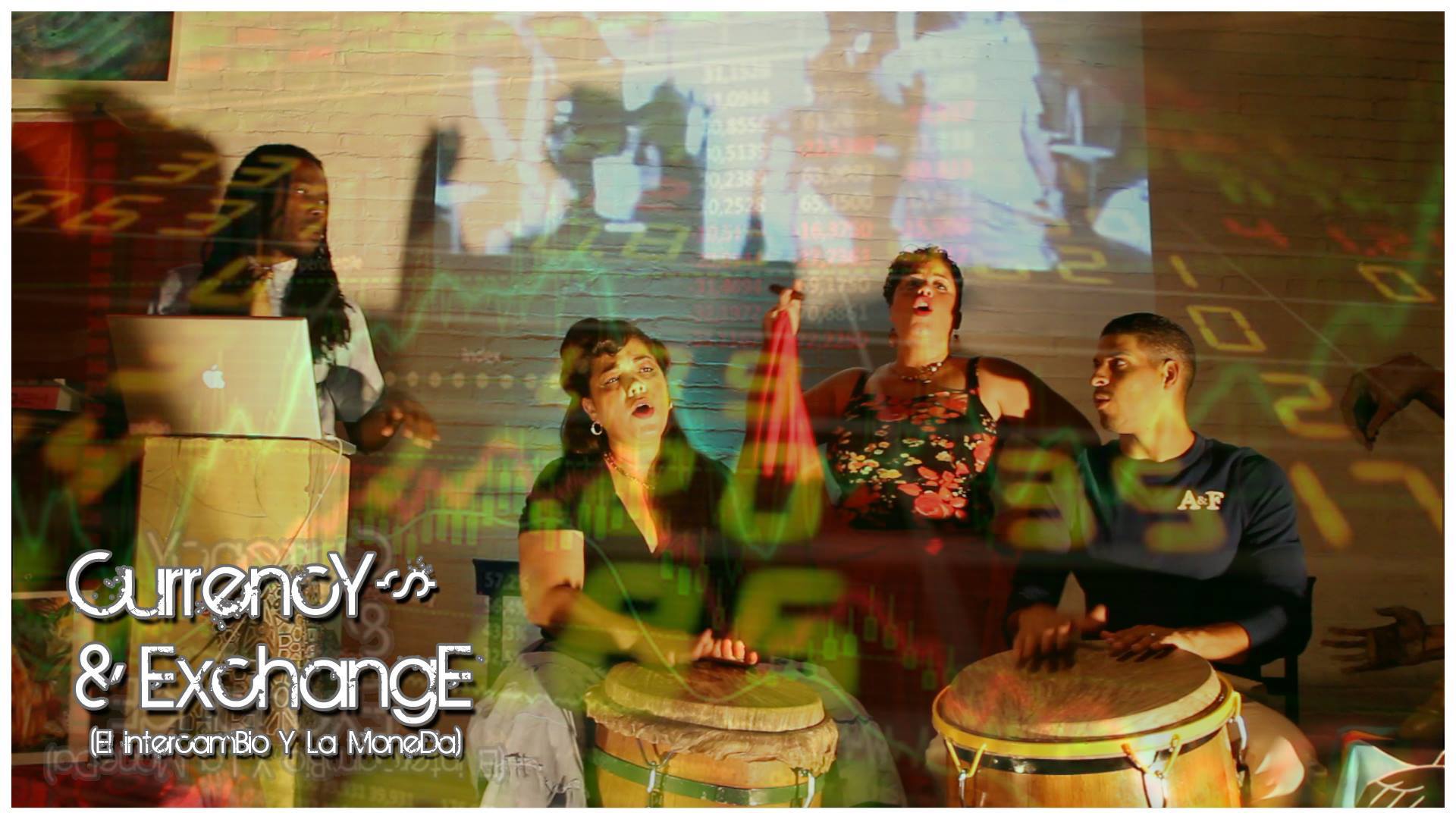
"Currency & Exchange" is a short film that will premiere Saturday, April 5.
Credit Bomba en Tampa
Gregorio Allende is the musical director of the Tampa group Nostalgia Amarilla. Bomba has different styles but most commonly it involves the instruments, a lead singer and chorus and dancers. Allende first experienced the music at the end of the street he lived on in Puerto Rico.
“At the corner up from my dad’s street, every Sunday, like legendary bomberos would be drumming, nonstop and then, one of the neighbors said, 'dale dale, baila baila!'  like I don’t how to dance! 'Haz asi' she told me, 'go like this, go like this' and that’s how it started," Allende said. "I fell in love."
Bomba also involves an element called piquete. That is the phenomenon where at any moment a dancer can approach the lead drummer and make eye contact and initiate a challenge to the drummer, who will attempt to make sounds on the drum that correspond to the movements of the dancer.
“What makes bomba special is that you have that opportunity - it’s not a necessity, to do that with the lead drummer," said Hal Barton, associate professor of anthropology at Long Island University in New York.
Bomba has strong roots in Puerto Rico going back about 400 years. For Allende, it's part of his identity.
“Some people wear Puerto Rican shirts with the flags or they put the Puerto Rican flag in their cars, I don’t," Allende said. "I carry bomba inside of me, that’s enough. That’s way more than enough so that’s what I love, it’s mine and nobody can take it away.”
Bomba is not just Puerto Rican. Bomba rhythms are a part of a bigger umbrella of African Diaspora music. Bomba elements cross the island's barriers.
“It’s not just significant in terms of understanding Puerto Rico, Puerto Rican bomba is very significant for understanding American music," Barton said.
Barton says bomba was cultivated on different lands from seeds originally planted in Africa.
“Bomba is the trunk of the tree, everything else is roots and branches," Barton said. "Blues, jazz, R&B, hip-hop, all the stuff going on in the African-American music, all the stuff going on in Afro-Caribbean music, Afro-Cuban music, the Eastern Caribbean - all of that, those are all roots and branches.”  
Those branches and roots can't be separated, he said.
“It’s because of the rhythm, it’s because of the language of the body, it’s because of the melody and the ways that the songs are sung," Barton said. "It’s all connected.”
Allende has connected some of his songs in a short film he produced called "Currency and Exchange." He'll be premiering it Saturday. Currency and Exchange are economic terms. What does that have to do with music and culture?
“The deeper theme is how much do we really value this music?" Allende said. "What are we doing so that this music is worth more for us and for everybody else? If we make it worth more, others will make it the same worth that we give it. So let’s give it the best worth we can.”
The show starts at 8 P.M. on Saturday at the Simone Salsa Dance School in Tampa.
For the original article go to: http://wusfnews.wusf.usf.edu/post/bomba-music-transcends-barriers

Saturday, March 15, 2014

Wednesday, August 21, 2013

NY Bomba: Bomba Yo presents Brendaliz Cepeda (and the Cepeda family's Bomba story) - Sunday August 25, 2013

Bomba Yo presents Brendaliz Cepeda, Ms. Cepeda will be sharing her family's contributions to Bomba.

ALL PARTICIPANTS MUST RSVP - info@bombayo.org
Date: August 25, 2013
Time: 12pm -3pm
Location: Casabe Houses at 150 East 121 Street between Lexington & 3rd Avenue, New York, NY.